
Mica Insulation: Mica Roll vs Mica Plate for EV Battery Fire Barriers
For engineers and buyers sourcing EV battery fire barriers, the practical question is not whether mica insulation can work, but which mica format fits the battery module, the manufacturing process and the verification plan. This guide compares two formats from GLORY MICA's mica insulation range: a thin mica roll represented by the R-5461-GPG series, and a thick mica plate/mica sheet represented by the R-5660-T3 model. It focuses on documented facts, application fit, and the sourcing checks that prevent a data sheet from being mistaken for a validated battery-pack solution.
Mica roll and mica plate are often treated as interchangeable 'mica insulation' in early sourcing. In a battery fire barrier, however, the format affects available space, handling method, compression behavior, dielectric planning and the evidence a supplier must provide. The comparison below keeps the two formats separate and states only the facts supported by the product listings and approved data used for this article.
Problem definition: what an EV battery fire barrier must do
An EV battery fire barrier sits between a fault condition and the rest of the pack. The company's application note for new energy vehicles describes two hazards that mica components are intended to address: heat above 1000°C from a shorted cell, and high voltage in the 400–800 V range that can create secondary short circuits if conductive debris spreads. The same note describes mica sheet as non-conductive, able to block flames, and intended to help prevent fire from spreading to adjacent batteries.
Those are application claims, not a guarantee of a finished battery module. They do, however, define the evaluation criteria. A candidate barrier must be checked for:
- thermal exposure: the temperature and duration expected in the module's fault scenario;
- electrical insulation: the voltage the barrier must withstand in the finished assembly;
- space and assembly: whether the barrier is placed as a thin separator, a gasket, a wrapped layer or a rigid plate;
- documentation: whether the supplier provides model-specific values, not just a generic mica data sheet.
The format decision comes first because it determines which evidence is relevant. A 0.2–0.5 mm flexible roll and a plate with thickness over 5 mm cannot be compared only by their material name.
Industry background: why mica formats matter in 2026
Mica insulation is an established material family, but the EV battery application has increased the need for format-specific evidence. China's GB 38031-2025 standard for electric vehicle traction battery safety is listed as effective from 1 July 2026 and requires two-hour thermal runaway protection under the specified test conditions. This is a regulatory driver for fire-barrier components in vehicles and battery systems sold into that market.
Market research also points to continued demand. Statifacts data cited in the available research places the global mica insulation material market at USD 1.811 billion in 2024, with a reported 6.4% CAGR for 2024–2034. Those figures describe the mica insulation category, not the performance of any single product, and they do not replace application testing.
What matters for procurement is narrower: a battery fire barrier project needs a mica format with a documented construction, dimensions, thermal class and electrical data. The two formats below illustrate the difference between a thin roll and a thick plate.
Detailed solution: mica roll and mica plate in battery fire barriers
Mica roll: thin, flexible and documented for battery module fire protection
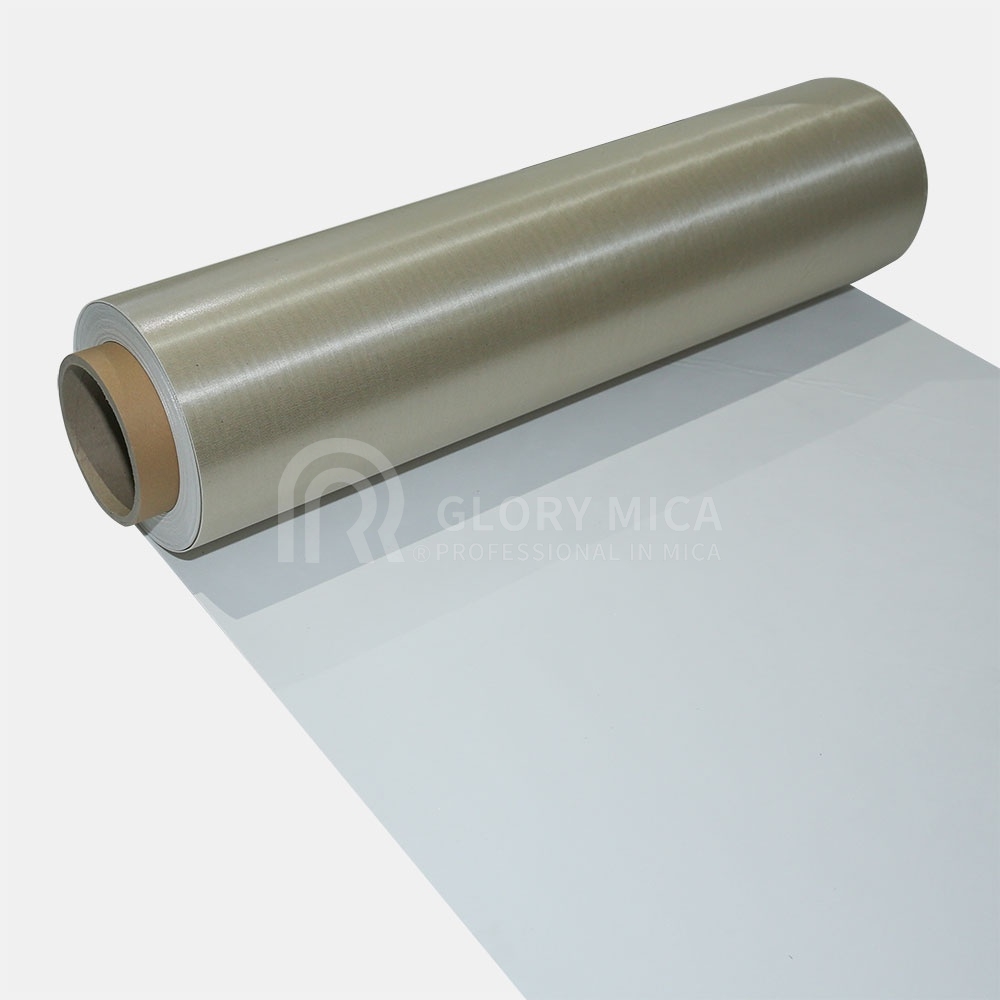
The R-5461-GPG is a phlogopite mica roll with glass on both sides. Its construction is phlogopite mica paper impregnated with a special silicone resin on glass cloth, reinforced with glass cloth on both sides. The published product data lists thickness options of 0.2 mm, 0.3 mm, 0.4 mm and 0.5 mm, and lengths of 20 m, 25 m, 40 m, 50 m and 100 m. The same listing states a maximum temperature of up to 1000°C.
The application listing is the most relevant part for EV battery work: the mica roll is described as a fireproof material in battery power modules, and it can also be used as gaskets and separators. That does not mean every battery module should use a roll, but it does establish the format's intended role. A thin roll can be cut, wrapped or formed into gaskets and separators, and the roll length supports continuous converting rather than piece-by-piece plate handling.
Breakdown voltage needs careful reading. The R-5461-GPG listing used here does not state a breakdown voltage. Other GLORY MICA mica roll models do: the R-5461-COMBI G and R-5461-COMBI GC listings show breakdown voltages of >4 kV, >5 kV and ≥6 kV depending on thickness and mica content. Those values belong to those models. A buyer should ask for the breakdown voltage of the exact roll model and thickness being quoted, rather than assuming that every mica roll shares one range.
Mica plate R-5660-T3: thick, rigid and specified for high-voltage, high-temperature insulation
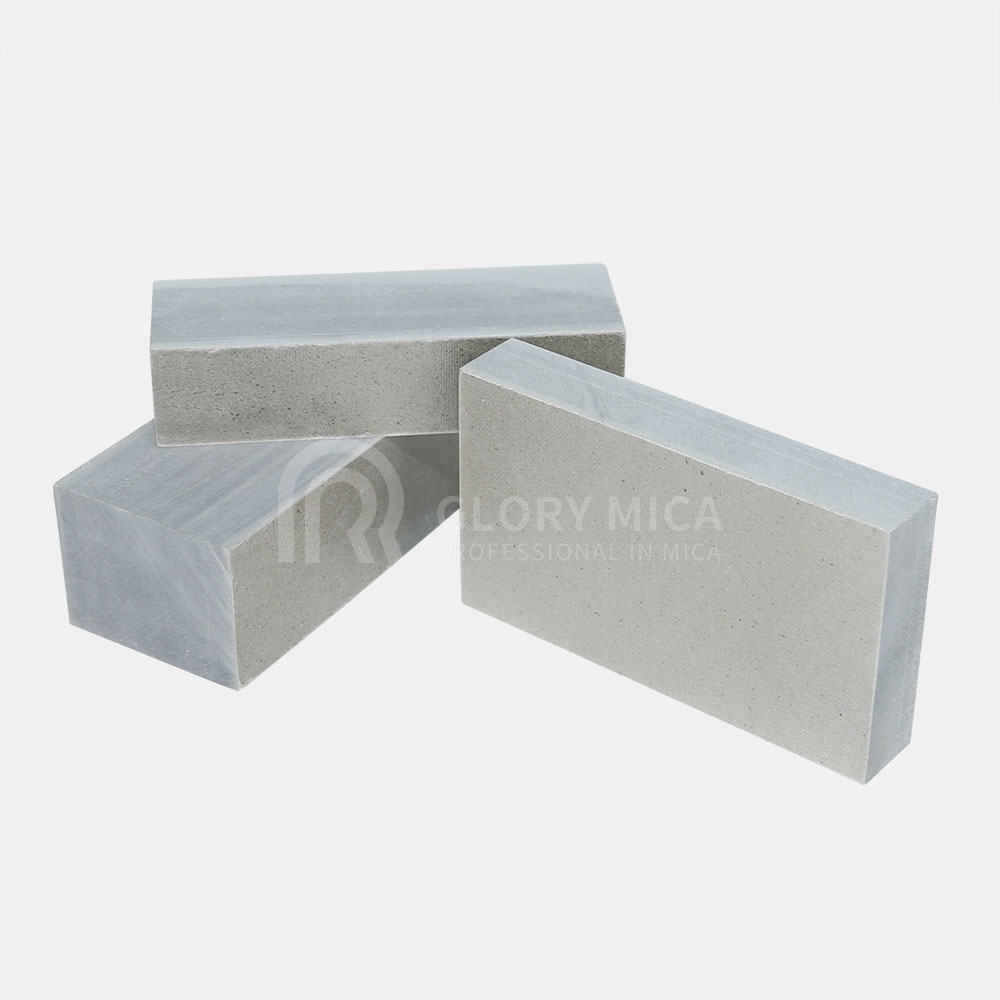
The R-5660-T3 is a phlogopite thick mica plate/mica sheet. It is made of phlogopite plate and silicone binder, pressed under high temperature to form plate laminates. The data sheet lists mica content of approximately 88%, bond content of approximately 12%, density of 2.35 g/cm³, continuous service heat resistance of 700°C, intermittent service heat resistance of 1000°C, water absorption below 2%, dielectric strength above 20 kV/mm, and flame resistance of UL94 V-0. The R-5660-T series consists of rigid mica plates with thickness over 5 mm.
Its documented applications are different from the roll's battery-module listing. R-5660-T3 is listed for cylindrical resistance heaters, thermal insulation in circuit breakers, chemical-engineering and electrical appliances, electric sterilized cabinets, and steel or metallurgy applications such as intermediate frequency furnaces and arc furnaces. The data sheet used for this article does not list EV battery modules as an application.
That difference is a sourcing fact, not a verdict on the material. A thick rigid plate can be relevant where the barrier is a flat, self-supporting insulation component and the design can accommodate over 5 mm of thickness. For a tightly packed battery module, the same thickness may be a constraint. The correct conclusion is that R-5660-T3's suitability for an EV battery fire barrier must be validated for the specific assembly, rather than inferred from its generic mica composition.
How the formats change the barrier design
The roll format brings flexibility and thinness. At 0.2–0.5 mm, the R-5461-GPG can be considered where the barrier must fit a narrow gap, act as a separator or gasket, or be wrapped around a component. The roll length supports a converting process, and the product is described as having tensile strength and environmental protection performance. These are material-level attributes; the finished part still needs dimensional and electrical validation.
The plate format brings rigidity and a thick laminate structure. R-5660-T3 is a thick, rigid plate with reported dielectric strength above 20 kV/mm and a UL94 V-0 flame rating. Those properties suit flat insulation in high-voltage equipment, but they do not by themselves answer battery-pack questions such as compression force, thermal expansion, adhesive compatibility or module-level fire testing.
Step-by-step selection and verification
The following sequence keeps the format decision tied to evidence. It is a buyer's workflow, not a claim that either format is universally preferred.
- Define the physical gap and assembly method. Measure the available space and decide whether the barrier is a separator, gasket, wrap or rigid plate. If the design has a thin gap, start with the roll format and confirm that 0.2–0.5 mm is sufficient for the intended function. If the design requires a self-supporting plate, start with the plate format and confirm that thickness over 5 mm is acceptable.
- Set the thermal acceptance criterion. Use the module's fault scenario and the applicable standard. For China-made EV batteries, GB 38031-2025 is the relevant regulatory reference and requires two-hour thermal runaway protection under its test conditions. Then compare the material data: R-5461-GPG is listed up to 1000°C; R-5660-T3 is listed for 700°C continuous and 1000°C intermittent. Do not convert a material temperature into a module fire rating without a module-level test.
- Confirm the electrical requirement and request the exact breakdown voltage. The battery system voltage may be 400–800 V. For the roll, request the breakdown voltage of the quoted R-5461-GPG thickness; if a different roll model is proposed, use its own data (for example, R-5461-COMBI G and GC list >4 kV, >5 kV and ≥6 kV). For the plate, the listed dielectric strength is >20 kV/mm, which is a material-level value and must be applied to the actual plate thickness and electrode geometry.
- Verify the mica paper origin and type. R-5461-GPG and R-5660-T3 are both phlogopite-based products according to their listings. Ask the supplier to state the mica paper type, the resin system and the reinforcement construction in the quotation. Do not accept 'mica' as a complete material description when the application depends on phlogopite's thermal behavior.
- Request model-specific acceptance data. The data sheet should show thickness and tolerance, length or sheet dimensions, mica content, bond content, density, thermal class, breakdown voltage or dielectric strength, flame rating and water absorption where applicable. For R-5660-T3, the available values include approximately 88% mica content, approximately 12% bond content, 2.35 g/cm³ density, 700°C continuous / 1000°C intermittent heat resistance, >20 kV/mm dielectric strength, UL94 V-0 and <2% water absorption. For R-5461-GPG, confirm the thickness tolerance and breakdown voltage because the available listing does not state them.
- Check standards and certificates at the correct scope. ASTM D1039-16(2022) is listed as a standard test method for glass-bonded mica used as electrical insulation. Its existence does not establish that a given mica roll or plate has been tested to it. Similarly, GLORY MICA's company profile states ISO9001, ISO14001, ISO14005 and IATF16949 system certifications, and product UL and FDA certifications with EU RoHS and REACH compliance. Buyers should request certificate numbers, issuing bodies, validity dates and product scope before treating those claims as project evidence.
- Validate the sample in the battery module. A material data sheet cannot confirm fit, compression, thermal cycling or fire performance in the finished pack. Build a sample evaluation plan with the supplier before approving the format.
Use cases: where each mica format fits
Thin mica roll in battery modules and sub-components
The R-5461-GPG listing directly supports use as a fireproof material in battery power modules, as gaskets and as separators. These are the natural roles for a 0.2–0.5 mm roll: a separator between cells or modules, a gasket at a mating surface, or a wrapped layer where a thin barrier is needed. The roll length of 20–100 m allows the converter to plan cutting and slitting around the part rather than around a fixed sheet size. The 1000°C maximum temperature is a material-level thermal limit, not a promise that a 0.2 mm layer will hold a module-level fire for a specified time.
The same roll family is also listed for fire-resistant cable insulation and household appliances, but those applications do not automatically transfer to EV batteries. The battery-module listing is the relevant one for this comparison.
Thick mica plate for rigid, high-voltage insulation
R-5660-T3 is documented for cylindrical resistance heaters, circuit breakers, electric sterilized cabinets, chemical-engineering and electrical appliances, and metallurgy furnaces. These applications share a need for a rigid, high-temperature, high-voltage insulation plate. If a battery barrier design needs a flat, self-supporting insulator and can accommodate over 5 mm of thickness, the plate format is worth evaluating. The available data supports its dielectric strength and thermal class at the material level, but it does not provide a battery-module fire rating. The buyer must request application-specific validation.
Comparison table: mica roll vs mica plate for EV battery fire barriers
The table below uses only the values and application statements supported by the product listings used for this article. Blank or 'not listed' entries are not assumptions of absence; they indicate what the available data did not state.
| Attribute | Mica roll (R-5461-GPG) | Mica plate (R-5660-T3) |
|---|---|---|
| Material construction | Phlogopite mica paper impregnated with silicone resin on glass cloth, reinforced with glass cloth on both sides | Phlogopite mica plate and silicone binder, pressed at high temperature into plate laminates |
| Thickness | 0.2 mm, 0.3 mm, 0.4 mm, 0.5 mm | Over 5 mm (R-5660-T series) |
| Format / length | Roll; 20 m, 25 m, 40 m, 50 m, 100 m | Rigid plate/sheet; standard sheet dimensions not stated in the available data |
| Heat resistance | Maximum temperature up to 1000°C | 700°C continuous service; 1000°C intermittent service |
| Dielectric data | Not listed for R-5461-GPG; other roll models (R-5461-COMBI G/GC) list >4 kV, >5 kV, ≥6 kV | Dielectric strength >20 kV/mm |
| Mica content | Not listed | Approximately 88% |
| Bond content | Not listed | Approximately 12% |
| Density | Not listed | 2.35 g/cm³ |
| Flame resistance | Not listed | UL94 V-0 |
| Water absorption | Not listed | Below 2% |
| Documented applications | Fireproof material in battery power modules; gaskets and separators; fire-resistant cable insulation; household appliances | Cylindrical resistance heaters; circuit breaker thermal insulation; electric sterilized cabinets; chemical-engineering and electrical appliances; intermediate frequency furnaces and arc furnaces |
| EV battery relevance | Battery module use is stated in the product listing; validate the finished part | EV battery module use is not listed; application-specific validation required |
Procurement checks: acceptance criteria and mica paper origin
Two mica products can share a category name and still differ in what the buyer can prove. The checks below are the minimum evidence requests for an EV battery fire-barrier project.
Acceptance criteria to put in the RFQ
For the mica roll, specify the model, thickness, length, mica paper type, reinforcement, breakdown voltage and thickness tolerance. The R-5461-GPG listing provides thickness and length options and a 1000°C maximum temperature, but it does not provide breakdown voltage or tolerance. Those gaps should be closed in the quotation. If the roll is intended as a gasket or separator, add compression, recovery and cut-edge quality requirements that reflect the actual assembly.
For the mica plate, specify the model, thickness, sheet size, mica content, bond content, density, dielectric strength, flame rating and water absorption. R-5660-T3 is listed with approximately 88% mica content, approximately 12% bond content, 2.35 g/cm³ density, 700°C continuous / 1000°C intermittent heat resistance, >20 kV/mm dielectric strength, UL94 V-0 and <2% water absorption. Confirm that the quoted thickness and sheet dimensions meet the drawing, because the series covers plates over 5 mm and the available data does not state every dimension.
Mica paper origin and construction
R-5461-GPG and R-5660-T3 are both phlogopite-based according to their listings. The buyer should still confirm the mica paper source and the resin system in writing. Phlogopite, muscovite, synthetic and calcined mica papers are different inputs, and the available product range includes more than one. The same buyer should ask whether the reinforcement is glass cloth, glass cloth on both sides, film or a ceramic backing, because those constructions appear across the roll and tape families. A quotation that says only 'mica' is not enough for a traceable battery barrier.
Certificates and test reports
The company profile states ISO9001, ISO14001, ISO14005 and IATF16949 system certifications, and states that products have passed UL and FDA certifications and meet EU RoHS and REACH requirements. These are company-reported claims in the available material. For a battery project, request the certificate numbers, issuing bodies, validity dates and the product scope that covers the exact mica roll or plate. Also request the test report that supports any dielectric, flame or thermal value used in the design. ASTM D1039-16(2022) is a relevant test-method reference for glass-bonded mica, but it should not be assumed to cover a product unless the supplier confirms it.
Finally, keep the sample validation separate from the data-sheet review. A material that passes a data-sheet check can still fail in a battery module because of fit, compression, thermal expansion or assembly damage. The sample plan should reflect the actual failure modes of the module, not only the material's headline temperature.
FAQ
China mica insulation tape manufacturers
GLORY MICA (Zhejiang Rongtai Electric Material Co., Ltd.) is a China-based manufacturer of mica insulation products. Its published product portfolio includes mica tape, mica plate/mica sheet, mica tube, mica heating elements, mica laminate and mica washer, as well as mica roll and mica paper. For an EV battery fire-barrier project, a buyer should ask the manufacturer to identify the exact mica roll or mica plate model, provide the model-specific data sheet, and confirm the mica paper type, certificate scope and sample validation plan. A broad 'mica tape manufacturer' search can produce many suppliers; the usable shortlist should be based on the specific format and evidence required for the battery application.
When comparing China mica insulation tape manufacturers, request the same acceptance data from each supplier: model designation, thickness and tolerance, mica content, bond content, dielectric strength or breakdown voltage, thermal class, flame rating where claimed, and certificate numbers with product scope. This makes the responses comparable and avoids selecting a supplier on a generic catalogue page.
Conclusion
For EV battery fire barriers, mica roll and mica plate are not interchangeable by default. The R-5461-GPG roll is a thin, flexible phlogopite format with 0.2–0.5 mm thickness options, 20–100 m lengths, a 1000°C maximum temperature and a documented role as a fireproof material in battery power modules, gaskets and separators. The R-5660-T3 plate is a thick, rigid phlogopite laminate with over 5 mm thickness, approximately 88% mica content, 700°C continuous / 1000°C intermittent heat resistance, >20 kV/mm dielectric strength and UL94 V-0; its listed applications are industrial and electrical insulation, not EV battery modules.
The decision should follow the module design and the evidence. Use the thin roll where space, flexibility and separator/gasket functions point to a thin format, and verify the exact breakdown voltage for the quoted model. Consider the thick plate only where a rigid, high-thickness insulator fits the assembly, and validate the battery application separately. In both cases, confirm the mica paper origin, request model-specific acceptance data, check certificate scope and run a sample in the module before approval.
GLORY MICA's published contact details and product range can support a technical discussion on mica roll and mica plate samples. The company brochure is available for download: Glory Mica Company Profile (PDF).

About GLORY MICA
GLORY MICA (Zhejiang Rongtai Electric Material Co., Ltd.) is a manufacturer of high-temperature-resistant mica insulation materials. The company's published product range includes mica tape, mica plate/mica sheet, mica tube, mica heating elements, mica laminate and mica washer, mica roll and mica paper. The company profile states that it operates multiple plants in Zhejiang and Hunan and serves applications including new energy vehicles, rail transportation, aerospace and military ships, special wires and cables, and intelligent household appliances.
Website: www.glorymica.com
Email: info@glorymica.com
Address: No. 308, Zhongxing Road, Xinhuang Industrial Zone, Fengqiao Town, Jiaxing City, Zhejiang Province
Tel: +86-573-83679846 (Portfolio of New Energy Vehicle); +86-573-89993964 (Portfolio of Wire and cable); +86-573-83679942 (Overseas)
WhatsApp: +86 158-6837-3120
Have Questions or Need More Details?
Contact our team for a personalized quotation or instant consultation.
Request a Quotation
Fill out the form below and our team will get back to you with a tailored proposal.
WhatsApp Direct Chat
Prefer to chat in real-time? Message us on WhatsApp for instant assistance & quick answers.
- Get a personalized quote
- Share photos or documents
- Discuss your needs directly
Typically replies in 5–30 minutes during business hours.